Why Does BPH Happen?
 As men get older, hormonal changes can cause the prostate to grow. This growth is not cancerous, but it can lead to uncomfortable symptoms because the prostate sits right around the urethra.
How Does BPH Affect Urination
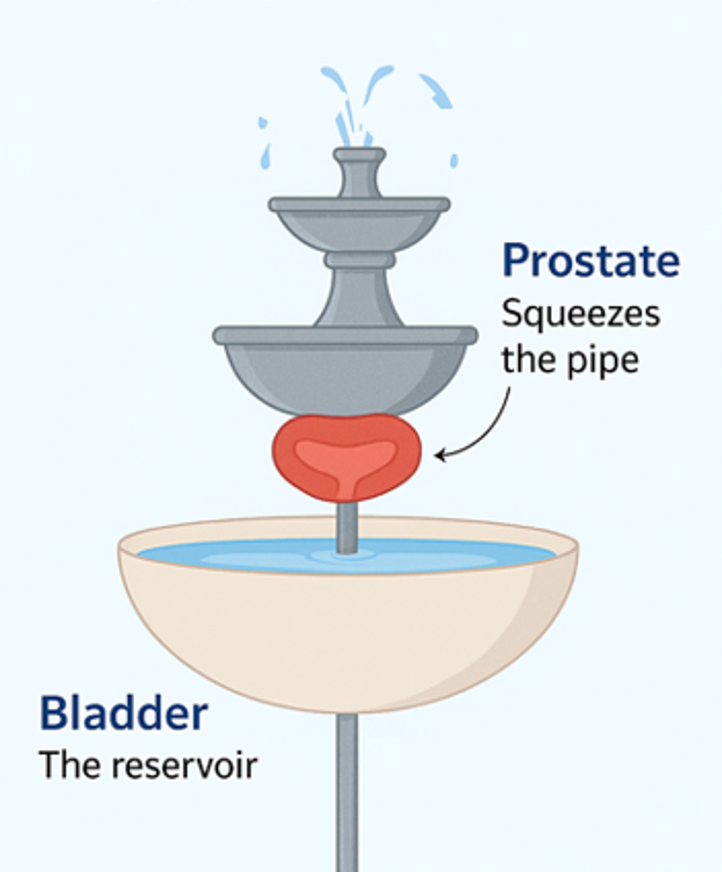
Imagine your urinary system as a garden fountain:
• The bladder is the fountain’s water reservoir.
• The urethra is the narrow pipe through which water flows out, creating the fountain’s stream.
• The prostate is like a ring or collar around that pipe, just below the reservoir.
When the prostate is healthy and normal-sized, water (urine) flows freely through the pipe, and the fountain’s stream is strong and steady.
But as the prostate grows (like A ring thickening around the pipe), it compresses the pipe, making it harder for urine to flow. The fountain’s stream becomes weak, sputters, or even dribbles. Sometimes, not all liquid is able to flow out of the reservoir, and there is a need to empty it more often.