Benign Prostatic Hyperplasia (BPH) is a common, non-cancerous enlargement of the prostate gland that affects nearly all men as they age. The prostate surrounds the urethra (the tube that carries urine out of the body), and as the prostate enlarges, it can compress the urethra and cause bothersome urinary symptoms.
Common BPH Symptoms
- Frequent or urgency of urination (sudden strong need to urinate)
- Waking up multiple times a night to urinate (nocturia: nighttime urination)
- Difficulty starting urination (hesitancy)
- Straining to urinate
- Weak urine stream or interrupted urine stream (intermittent or stop-and-start flow)
- Dribbling after urination
- Feeling that the bladder isn’t fully empty (incomplete bladder emptying)
Why Does BPH Happen?
As men grow older, the prostate grows larger (enlarged prostate) with speed of growth affected by natural hormones in the body, genetics, and various lifestyle factors. This growth is not cancerous, but can lead to increasingly bothersome urinary symptoms as the prostate becomes increasingly larger.
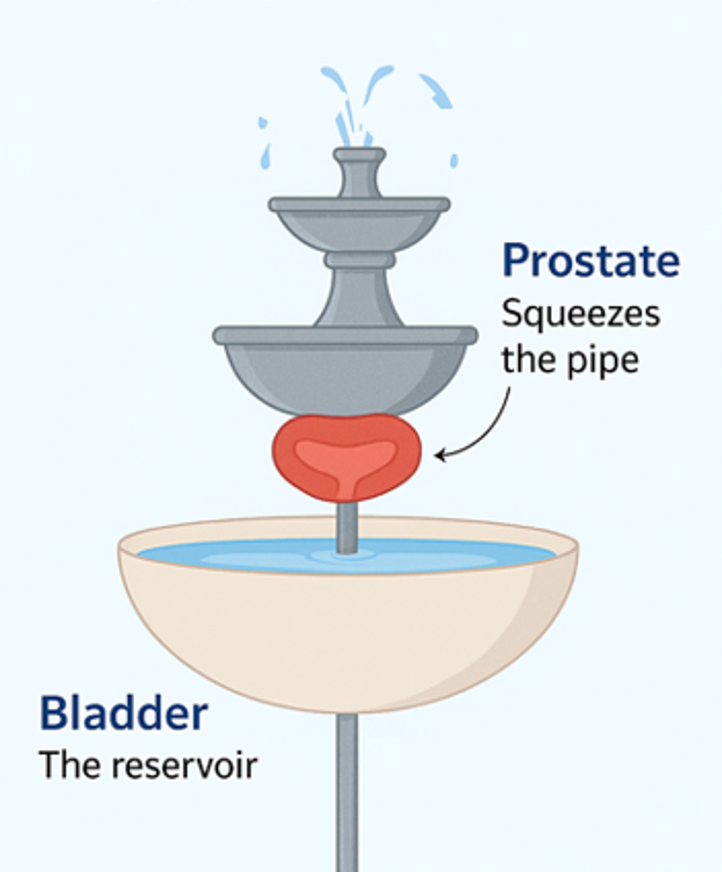
How Does BPH Affect Urination?
Imagine your urinary system as a garden fountain:
- The bladder is the fountain’s water reservoir.
- The urethra is the narrow pipe through which water flows out, creating the fountain’s stream.
- The prostate is like a ring or collar around that pipe, just below the reservoir.
When the prostate is healthy and normal-sized, water (urine) flows freely through the pipe, and the fountain’s stream is strong and steady.
But as the prostate grows (like a ring thickening around the pipe), it compresses the pipe, making it harder for water (urine) to flow through. The fountain’s stream becomes weak, sputters, intermittent (stop-and-start flow), causes difficulty urinating, or even dribbles. Sometimes, not all water (urine) is able to flow out of the reservoir, and there is a need to empty it more often.
How is BPH (Enlarged Prostate) Treated?
Management of BPH depends on your symptoms, health, and preferences. Options range from lifestyle changes to treatments that include medications and minimally invasive surgical procedures.
Lifestyle Changes
Managing BPH symptoms can involve simple lifestyle changes like reducing fluids before bed, limiting caffeine and alcohol, and staying active.
Medications for BPH
Medications can help, but can have side effects that include dizziness, sexual dysfunction, or low blood pressure.
- Alpha-blockers such as Flomax (tamsulosin): Relax prostate and bladder muscles to improve urine flow.
- 5-alpha-reductase inhibitors such as Proscar (finasteride): Shrink the prostate over time.
Combination BPH Therapy
Sometimes used for more severe symptoms. Medical therapy requires taking medications daily on a continued basis as they help to address the effects of an enlarged prostate, but medications are not able to stop or reverse the continued growth of the prostate. As a result, over time, some patients may find that their symptoms persist or worsen despite treatment that was initially adequate.
Surgical Procedures for BPH
Surgical procedures may become necessary to consider when either medications are intolerable due to side effects or are no longer effective in managing an enlarged prostate. Minimally invasive surgical procedures may be preferred over medications in managing BPH because they may offer, in appropriately selected patients, lasting relief from urinary symptoms without the need for ongoing daily prescription medications.
In patients for whom medications cause significant, bothersome side effects or fail to fully resolve symptoms, minimally invasive surgical procedures can directly address the enlarged prostate, helping them to regain normal urinary function and improved quality of life.
- Transurethral resection of the prostate (TURP) or laser vaporization of the prostate (GreenLight Laser)
- Holmium enucleation of the prostate (HoLEP)
- Simple prostatectomy (open or robotic)
- Urolift uses small implants to lift and hold an enlarged prostate tissue away from the urethra
- Rezum uses water vapor to shrink excess prostate tissue
- Aquablation, an advanced AI and robotically guided waterjet-based treatment to precisely remove excess tissue caused by an enlarged prostate
The optimal surgical procedure for each patient depends on the patient’s prostate anatomy, size, and individual priorities. This requires a detailed evaluation and discussion with your urologist to determine the best option for you.
Expert-reviewed by Dr. Johnson Tsui, a leading area urologist known for his patient-centered approach and advanced training in treatment options including the revolutionary Aquablation, advanced water jet robotic procedure for treating BPH. Learn more about Griffin Faculty Physicians (GFP) Urology, and other GFP doctors at www.gfp.griffinhealth.org.